

30 Years of Willa Decjusza – exhibition 07.01.2026
We invite you to explore the renewed interiors of Willa Decjusza. In January and February, a temporary exhibition awaits you.
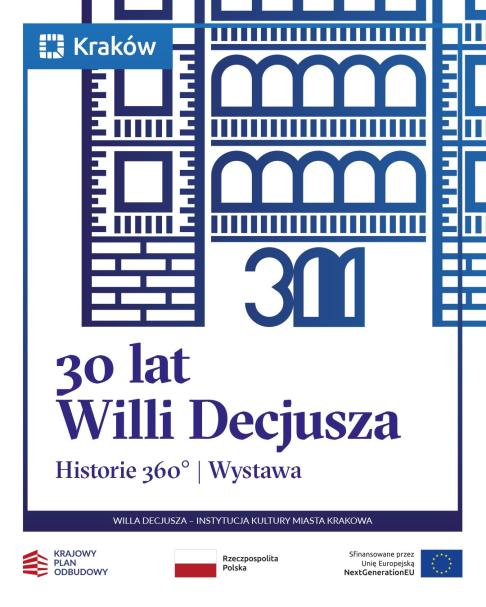
We invite you to visit Willa Decjusza and a unique temporary exhibition prepared to mark the 30th anniversary of the reopening of Willa Decjusza to the people of Kraków. The jubilee exhibition tells the story of a place that for three decades has remained a space for dialogue, culture, and encounters, connecting local heritage with a European perspective.
The exhibition is created using narrative mapping, a contemporary digital site-specific installation creatively integrated into the architecture of the Villa. An essential part of the display consists of invaluable archival materials, including photographs taken in the Kraków studio of Natan and Ignacy Krieger, commissioned by the Czartoryski family in the second half of the nineteenth century. This documentation allows visitors to see the interiors of the Villa at a time when it was owned by Princess Marcelina Czartoryska, who lived here and hosted one of the most important artistic salons of the era. These photographs constitute a unique testimony to the cultural life and aesthetic character of the Villa during a period when it was actively present on the map of European artistic exchange.
The exhibition is open from 15 January to 28 February, from Tuesday to Friday and on all Sundays, between 10:00 and 18:00, with the last entry at 17:30. We invite you to discover the history of Willa Decjusza in a new and moving form and to celebrate a place that for 30 years has remained open to the residents of Kraków and visitors from across Europe.
The exhibition is created using narrative mapping, a contemporary digital site-specific installation creatively integrated into the architecture of the Villa. An essential part of the display consists of invaluable archival materials, including photographs taken in the Kraków studio of Natan and Ignacy Krieger, commissioned by the Czartoryski family in the second half of the nineteenth century. This documentation allows visitors to see the interiors of the Villa at a time when it was owned by Princess Marcelina Czartoryska, who lived here and hosted one of the most important artistic salons of the era. These photographs constitute a unique testimony to the cultural life and aesthetic character of the Villa during a period when it was actively present on the map of European artistic exchange.
The exhibition is open from 15 January to 28 February, from Tuesday to Friday and on all Sundays, between 10:00 and 18:00, with the last entry at 17:30. We invite you to discover the history of Willa Decjusza in a new and moving form and to celebrate a place that for 30 years has remained open to the residents of Kraków and visitors from across Europe.
30th Anniversary of Willa Decjusza
At the end of the twentieth century, Europe remained a space of deep political divisions, shaped by the experience of wars, totalitarian regimes, and the split between East and West. Broken relationships, a lack of trust, and entrenched stereotypes meant that official politics alone was unable to rebuild understanding between societies. The need for actions that would offer a sustained process of dialogue and cooperation, grounded in culture and humanistic reflection rather than one-off gestures, became increasingly evident.
The idea of Willa Decjusza fits into this context but reaches much deeper, back to the sixteenth-century experience of the villa’s founder, Ludwik Justus Decjusz, an Alsatian and a migrant who chose Kraków as the place of his life. As the administrator of the royal salt mines and later a royal advisor and diplomat, he co-created the foundations of the modern Polish state, combining political practice with humanist thought. He was the author of scholarly treatises, the owner of an extensive library, and an active participant in the European exchange of ideas, maintaining correspondence with figures such as Martin Luther and Erasmus of Rotterdam.
The contemporary concept of Willa Decjusza refers to this dual perspective, both historical and modern. Just as in the time of Justus Decjusz the Villa was a meeting place for different languages, experiences, and ideas, at the end of the twentieth century it was conceived as a space of mediation between the divided parts of Europe. Its aim became the building of trust through art, scholarship, and dialogue, beyond political and mental borders. In this sense, for 30 years Willa Decjusza has remained a place where humanism and European exchange form the foundation for thinking about a shared future.
The exhibition is presented as part of the project “Historie 360°. 30 Years of the Opening of Willa Decjusza”, implemented with the support of the National Recovery Plan for Culture.

The idea of Willa Decjusza fits into this context but reaches much deeper, back to the sixteenth-century experience of the villa’s founder, Ludwik Justus Decjusz, an Alsatian and a migrant who chose Kraków as the place of his life. As the administrator of the royal salt mines and later a royal advisor and diplomat, he co-created the foundations of the modern Polish state, combining political practice with humanist thought. He was the author of scholarly treatises, the owner of an extensive library, and an active participant in the European exchange of ideas, maintaining correspondence with figures such as Martin Luther and Erasmus of Rotterdam.
The contemporary concept of Willa Decjusza refers to this dual perspective, both historical and modern. Just as in the time of Justus Decjusz the Villa was a meeting place for different languages, experiences, and ideas, at the end of the twentieth century it was conceived as a space of mediation between the divided parts of Europe. Its aim became the building of trust through art, scholarship, and dialogue, beyond political and mental borders. In this sense, for 30 years Willa Decjusza has remained a place where humanism and European exchange form the foundation for thinking about a shared future.
The exhibition is presented as part of the project “Historie 360°. 30 Years of the Opening of Willa Decjusza”, implemented with the support of the National Recovery Plan for Culture.